Strategic Yearly Planning: A Quarterly Framework
When it comes to executing high-level business strategies or managing a complex personal workflow, a standard monthly calendar often falls short. It creates a "tunnel vision" effect where you are constantly reacting to immediate deadlines rather than focusing on long-term growth. This is where the Yearly Planner Quarterly Template 1 enters the conversation. It is not merely a collection of dates; it is a comprehensive visual system designed to help you map out your entire year through the lens of four distinct quarters. By utilizing this specific layout, you can bridge the gap between your annual vision and your daily execution.
Analyzing the Visual Structure and Design Philosophy
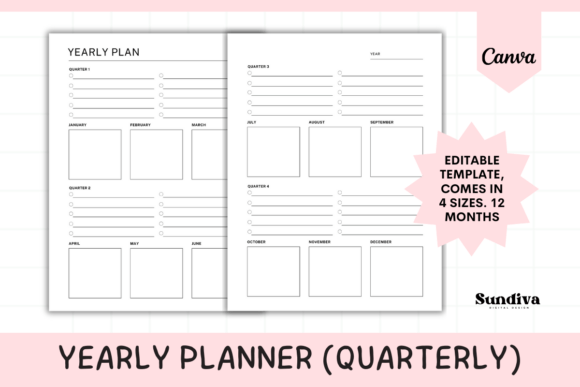
The core appeal of this template lies in its balance between structure and flexibility. In the world of editorial design, white space is just as important as the content itself. The Yearly Planner Quarterly Template 1 embraces this by offering a clean, uncluttered aesthetic. The layout is divided into four main sections—Q1 through Q4—allowing you to view the trajectory of your projects at a glance. Within these sections, you will find monthly empty boxes that serve as versatile containers for your ideas. Unlike rigid grids with pre-filled text, these blank spaces invite you to impose your own hierarchy. Whether you are sketching out a rough timeline or listing specific deliverables, the visual style remains professional and adaptable. The overall personality of the design is functional and modern, avoiding unnecessary ornamentation so that the focus remains entirely on your content.
Beyond the Grid: Bullet Lists and Prioritization
One of the most practical features included in this design asset is the integration of bullet list sections. In typography and layout theory, lists are essential tools for creating visual hierarchy. They allow the eye to scan information quickly. In the context of this yearly planner, these sections are perfect for defining quarterly objectives or listing non-negotiable tasks. For a marketer or entrepreneur, this might mean listing three key performance indicators (KPIs) for a quarter. For a crafter or hobbyist, it could be a list of materials needed for a seasonal project. The layout encourages you to separate the "what" (the monthly goals in the boxes) from the "how" (the specific tasks in the bullet points). This separation of concerns is a hallmark of good brand identity management—it keeps your strategy distinct from your tactics.
Practical Applications for Diverse Professionals
The versatility of the Yearly Planner Quarterly Template 1 makes it a valuable tool across a wide spectrum of industries. It functions less like a rigid form and more like a modular design asset.
For content creators and bloggers, the quarterly view is essential for mapping out content pillars. You can assign a theme to each quarter—perhaps "Launch," "Growth," "Community," and "Review"—and use the monthly boxes to schedule specific blog posts or social media campaigns. The visual clarity helps ensure that you are not repeating topics too frequently and that your content mix remains balanced.
Small business owners and publishers will find the structure particularly useful for inventory and sales planning. Retail cycles are inherently quarterly. By using this template, you can visually align your marketing efforts with your stock availability. For instance, if you are a publisher planning a book release, you can block out the "Pre-launch" phase in Month 1, the "Launch" in Month 2, and the "Sustain" phase in Month 3 of that specific quarter. This visual timeline acts as a roadmap for your entire team.
Even for personal use, the framework holds significant value. A designer working on a passion project or a student managing a semester can use the Half Letter or A5 sizes to create a portable planning system. The act of writing down quarterly goals in a physical planner has been shown to increase commitment to those goals. The "empty box" nature of the months allows for total customization—you aren't forced to plan every single day, which is often daunting, but rather to focus on monthly milestones.
Technical Specifications and Workflow Integration
Functionality is just as important as aesthetics. This planner is delivered as an editable Canva template, which democratizes the design process. You do not need to be a professional graphic designer to customize it. Canva operates on a freemium model, meaning the tools required to edit this template are accessible to anyone with a browser or a smartphone. This is particularly beneficial for entrepreneurs who need to make quick adjustments on the go. However, for the best experience, particularly when manipulating text blocks and adjusting layout elements, a computer is highly recommended over a mobile device.
Furthermore, the inclusion of printable PDF files ensures that this planner fits seamlessly into physical workflows. The files are optimized for multiple standard paper sizes: US Letter, A4, A5, and Half Letter. This range covers almost every standard binder and journal system on the market. If you use a ring-bound planner system like a Filofax or a Happy Planner, the A5 or Half Letter sizes are ideal inserts. For those who prefer digital planning on an iPad using apps like GoodNotes or Notability, the PDFs can be imported directly as hyperlinked (or non-hyperlinked) templates.
Optimizing Your Planning Process
To get the most out of the Yearly Planner Quarterly Template 1, consider adopting a "top-down" planning approach. Start by filling in the quarterly bullet lists with your overarching goals. These should be broad strokes—things like "Increase Revenue by 20%" or "Complete Website Redesign." Once those are established, move to the monthly boxes. Break those large goals down into smaller, actionable chunks. For example, if your Q1 goal is a website redesign, Month 1 might be "Wireframing," Month 2 "Design & Copy," and Month 3 "Launch & QA."
Because the template is editable, you can also use color coding to your advantage. In Canva, you can easily change the color of the text or add subtle background shading to the boxes to categorize different areas of your life or business. For example, use blue for work tasks, green for personal goals, and orange for health and wellness. This creates an immediate visual signal that helps you assess balance in your life at a glance.
Why a Quarterly View Matters
Annual planning often fails because a year is simply too long for the human brain to conceptualize effectively. We tend to overestimate what we can do in a year and underestimate what we can do in a month. The quarterly breakdown used in this planner aligns with how businesses operate and how natural seasons affect our energy and focus. It creates a rhythm of execution and review.
By using the Yearly Planner Quarterly Template 1, you are not just organizing dates; you are creating a strategic document. It forces you to think in phases. It encourages you to look at the empty boxes of the coming months not as voids to be filled with busyness, but as strategic slots to be filled with intention. Whether you are a marketer tracking a campaign, a blogger scheduling content, or a creative professional